Laying up your car for winter: what to do, what to skip
A practical checklist for putting a track or weekend car away for the cold months, covering fluids, fuel, battery, tyres, storage and the mistakes that cost people money in spring.
The last track day is done, the tyres are tired, and the forecast has gone grey. For most weekend and track cars, the next few months are a lay-up: the car goes in a garage, a barn or a lock-up and waits for spring.
Done well, a lay-up costs you an afternoon and a few small bills. Done badly, it costs you a flat battery, seized brakes, flat-spotted tyres, a mouse nest in the airbox and a tank of stale fuel. Almost all of that is avoidable.
This is a practical guide to what to consider, what to do, and what to leave alone.
Start with the plan
Before touching a spanner, answer three questions.
How long will it sit? A car parked for four weeks needs far less than one parked for five months. This guide assumes the long version.
Where will it live? Dry and ventilated beats everything else. A damp garage will undo half your good work through rust, mould and perished rubber. If your only option is a damp space, a dehumidifier or desiccant tubs are worth the money.
Will you actually leave it alone? The best lay-up is one where you also plan the winter jobs. Cars often sit all winter, then get rushed in March. Write the list now (see the end of this post).
Do: drive it, then service it
Take the car for a proper drive of at least 30 to 40 minutes at the end of the season so everything reaches full temperature. That burns off condensation in the engine, exhaust and gearbox, which otherwise sits there and does damage over winter.
Then, before it goes away:
- Change the engine oil and filter. Used oil carries acids and moisture, and you don’t want it sitting in the engine for months. Fresh oil protects over the winter. Do this at the end of the season, not the start of the next.
- Replace brake fluid if it’s due. Brake fluid absorbs water over time. Old fluid corrodes calipers and lines from the inside and lowers its boiling point, which you’ll notice on track first. If it’s been a year or more, now is a good time.
- Check coolant. Make sure the mix has proper antifreeze protection for your coldest nights. Frozen coolant can crack a block.
- Check other fluids. Gearbox, diff, power steering and clutch fluid. Note anything that looks old or contaminated.
Do: look the car over
The end of the season is the best time to find problems, because you have the whole winter to fix them.
- Pad and disc thickness, and any heat damage to discs
- Tyre condition, wear pattern and date codes (see our tyre guide)
- Suspension bushes, driveshaft gaiters, wheel bearings, and anything that clunked or smoked
- Leaks under the car, hoses and clamps
- Bolt checks on wheels, suspension, seats and harness mountings
Write down everything you find. Put it in your Outlap Garage notes next to the car, with photos, so the list is waiting for you in February instead of living in your head.
Do: fuel
Fill the tank, and add a fuel stabiliser if the car will sit for more than a couple of months, following the product’s instructions.
A full tank leaves little room for air, which means less condensation inside the tank, and fuel that has had less chance to go off. Modern pump fuel, especially blends with ethanol, can absorb water and degrade over a few months. A stabiliser slows that down.
If you add a stabiliser, run the engine for a few minutes afterwards so it circulates through the fuel system.
Do: clean it properly
Wash the car, including the underside and wheel arches, to remove road salt, brake dust and track rubber. Brake dust is corrosive and does real damage sitting on wheels and calipers.
Then dry it fully. Trapped water is the enemy for the next five months. Use a chamois or microfibre, open the doors, boot and bonnet, and let it air. Wax the paint for protection, and treat rubber seals so they don’t stick or perish.
Clean the interior too. Crumbs and old food attract mice. Remove anything damp, and take out loose carpets or mats to dry them separately.
Do: look after the battery
A battery left connected to a car will slowly go flat, and a flat battery that sits for weeks can be permanently damaged.
You have two sensible options:
- Use a smart battery maintainer (not a basic old trickle charger). It holds the battery at the right level without overcharging. This is the better option if you have a socket in your storage space.
- Disconnect or remove the battery, store it somewhere dry and cool, and charge it every month or so. If you disconnect it, be aware of any alarm, immobiliser and ECU memory.
Either way, never leave a deeply discharged battery in the cold. It can freeze and split.
Do: sort out the tyres
Long storage is hard on tyres. The weight sits on one patch, and the rubber can develop flat spots, which feel like a vibration when you first drive.
Choose one of these approaches:
- Best: raise the car on axle stands (placed on strong chassis points, as the manual describes), so the tyres carry no weight. Make sure the car is stable.
- Good: take the wheels off, bag the tyres, and store them off the floor, in a cool, dark place away from sunlight and electric motors. Store them upright, or stack them lightly.
- Acceptable: leave the wheels on, inflate the tyres a few psi above your normal pressure, and, if you can, roll the car a little every few weeks so it isn’t resting on the same spot.
Semi-slicks and race tyres are worth special care. Heat cycles and age matter more with these, and a set that’s had a hot season and a cold winter in a freezing shed may not be what you think it is in spring. Check them, clean them and decide honestly whether they’re done.
Do: protect it from the elements and animals
- Use a breathable car cover, not a plastic tarp. Plastic traps moisture against the paint and will cause damage. A soft, breathable, fitted cover keeps dust off and lets the car breathe.
- Block the entrances for mice and rats. Stuff steel wool or a mesh into the exhaust tailpipe and the air intake (and put a big reminder note on the steering wheel so you remember to remove it). Peppermint oil, sealed bait stations or a few traps around the car help.
- Open a window slightly if the space is damp and ventilated, or use moisture absorbers inside the car.
- Lift the wiper blades off the glass. Otherwise the rubber can stick.
Avoid: the common mistakes
Leaving the handbrake on. Pads can stick to the discs and, in damp air, rust together. Leave the car in gear (manual) or in park, with the handbrake off, and chock the wheels so it can’t move. If your rear brakes have a drum handbrake, even more reason not to use it.
“Just starting it up” now and then. This is the most common bad advice. Running the engine for a few minutes without getting it to full temperature produces moisture and fuel dilution, which sits in the oil and exhaust. That’s worse than leaving it alone. Either take it for a proper drive of 30 minutes or more, or don’t start it at all.
Storing it dirty or damp. Salt, mud and water trapped under the car are what rust is made of.
Storing it with an old battery connected and no maintainer. See above.
Cheap plastic covers. They hold moisture and rub the paint.
Parking it on grass or bare earth. Damp rises from the ground. If the surface isn’t concrete, put a damp-proof membrane or sheeting underneath.
Spraying oil on the brakes. Some people spray the discs with protectant. Don’t. Brake contamination is dangerous. Instead, make sure the discs are clean and dry, and expect a light surface rust that will wipe off on the first few stops.
Cancelling your insurance without checking. Laid-up or storage cover is often cheaper, and some policies cover fire or theft in storage at lower cost. Fully cancelling cover can leave you uninsured for damage at home. Check the terms, and check what your country and your vehicle licence need if the car is off the road (for example, in the UK, a SORN declaration).
Doing the winter jobs
The point of a lay-up isn’t to ignore the car. It’s to give yourself time to do things properly, rather than the night before a track day.
A good winter list might include:
- new pads and discs, and a brake fluid flush
- suspension bushes and a geometry check
- gearbox and diff fluid
- a fresh set of tyres, ordered early
- fixing the things you wrote down in November
- a thorough clean of the engine bay and underneath
Do the work in the order of risk. Brakes and tyres come first, because they are the things that matter at speed.
Waking it up in spring
When the days get longer:
- Inspect before you start. Look for leaks, rodent damage, and anything you stuffed in the exhaust or intake. Check the tyres for flat spots, cracks and pressure.
- Check fluids. Oil, coolant, brake and clutch levels.
- Reconnect the battery and check the charge.
- Pump the brakes before moving, and check the pedal feels firm.
- Start it and let it settle before you drive. Listen and look for warning lights.
- Drive gently first. Allow the tyres, brakes and fluids to come up to temperature, and shake it down on the road before you commit to a track day.
Then log it, and book the first event.
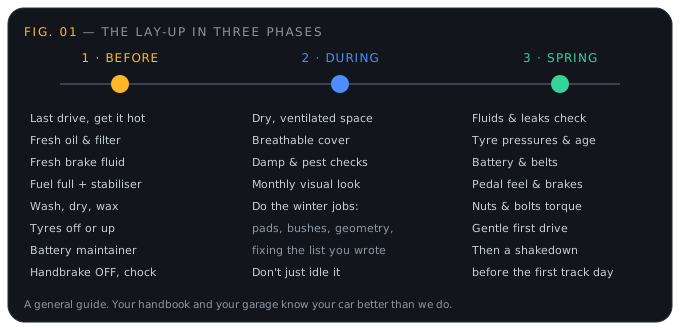
The short version
- Get it hot, then service it: oil, brake fluid, coolant.
- Fill the tank and stabilise the fuel.
- Wash it, dry it, and wax it.
- Keep the battery on a maintainer or take it out.
- Get the weight off the tyres, or protect them.
- Dry, ventilated storage, a breathable cover, and keep the mice out.
- Handbrake off, wheels chocked.
- Don’t idle it. Drive it properly or leave it alone.
- Use the downtime to fix what you found.
A tidy lay-up won’t make you any faster, but it will mean the first thing you do in spring is drive the car, not fix it.