Tyres on track days: wear, pressures and how to make a set last
What tyres are actually doing at a track day, why pressures matter more than compound, how to read wear, and a practical plan for managing a set across a day.
Ask a room of track day regulars what they’d upgrade first and you’ll hear brakes, suspension, power. Ask what actually changed their lap times and a surprising number will say tyres, and then admit they’d never once checked the pressures properly.
Tyres are the only part of the car that touches the road. Everything else is just a way of asking them to do more. Managing them well is the cheapest speed available, and it’s also what decides whether a set lasts one day or six.
This is a practical guide: what’s happening in the rubber, how to read what it’s telling you, and a plan you can follow on the day.
What a tyre is doing out there
Grip on a track tyre isn’t a fixed number. It depends on temperature, and each tyre you use will have a working window.
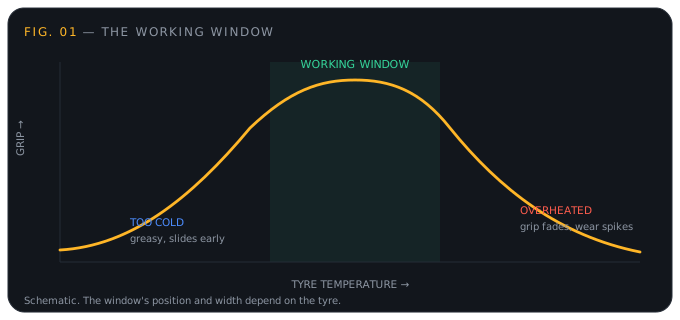
- Too cold: the rubber is stiff, thus grip is low, and the car feels greasy and snappy. This is the first couple of laps, and it’s why people spin on out-laps.
- In the window: your grip peaks, the car feels planted, and wear is steady.
- Overheated: the surface starts to break down, grip fades lap on lap, and wear speeds up sharply. This is the last laps of a long, hard session.
Almost everything in tyre management is about getting into the window quickly and staying in the top half of it without going over.
Two things move the temperature: how hard you work the tyre (cornering load, wheelspin, sliding) and the pressure, because air pressure rises as the tyre heats. That second one is why pressures matter so much.
Compounds, briefly
Road tyres, 200-treadwear “extreme performance” tyres, semi-slicks and full slicks are really a spectrum from long-lasting-and-forgiving to grippy-and-short-lived.
| Type | What to expect |
|---|---|
| Road / summer performance | Fine for a first day. Heat up slowly, slide progressively, wear fastest on the shoulders if you push hard. |
| 200tw extreme performance | The sweet spot for most track day drivers. Real grip, still road legal, last several days if looked after. |
| Semi-slick | Much more grip, narrower working window, often needs more care with warm-up and cool-down. |
| Slick | Maximum grip, very specific pressures and temperatures, and not forgiving of mistakes. Most people don’t need them. |
A softer compound isn’t automatically faster for you. If it lasts three sessions and goes off in the fourth, a harder tyre you can use all day may give you more usable laps. Match the tyre to the length of your day, not to a lap record.
Pressure is the thing you control
Pressure sets the shape of the contact patch. Too much and the middle bulges and carries the load. Too little and the shoulders do. Either way you’re using only part of the tread.
The number that matters is hot pressure: what’s in the tyre right after a session, not what you set in the paddock.
A typical routine:
- Start cold, lower than road pressure. Track tyres are usually run noticeably lower than road pressure, because they gain a lot as they heat. The exact figure depends on the tyre, the car’s weight and the circuit, so start from the manufacturer’s guidance and your own notes.
- Check hot pressures straight after a session. In the pit lane, with a good gauge, before they cool.
- Compare with the target. Many people aim for a hot pressure in a window the tyre maker publishes or the tyre’s own supplier suggests, adjusting a couple of psi at a time.
- Adjust the cold pressure to reach it next time. If you came back 3 psi over target, let that much out cold and try again.
Change one thing at a time and write it down. A spare gauge is cheap, and a gauge you trust is worth more than any single setup change.
A worked example: the Michelin Pilot Sport Cup 2
Plenty of people at a track day are on Pilot Sport Cup 2s, so let’s use them. They’re a road-legal semi-slick: a lot more grip than a normal summer tyre, a longer life than a competition tyre, and a clear need for heat. Outlap’s tyre library lists the Cup 2 with a 28-34 psi pressure range and a 40-80°C working temperature range, and notes that it needs heat to work and that wear climbs dramatically in the wet. Treat those as a starting window, not a rule. Your car, its weight and the circuit move the answer, and Michelin’s own guidance for your fitment comes first.
Here’s how a day on them might go. The numbers below are illustrative, not a recommendation for your car.
| Step | What you do | Why |
|---|---|---|
| Cold, in the paddock | Set a little under where you expect to finish, say 26-27 psi | They’ll gain several psi as they heat |
| Session 1, laps 1-2 | Build speed gradually, no big slides | A Cup 2 is stiff and slippery when cold. Heat it through the whole tyre, not just the surface |
| Hot check, pit lane | Read each corner straight after the session. Suppose you see 33 front, 31 rear | Inside the 28-34 window, but fronts are near the top |
| Adjust | Take 1-2 psi out of the fronts cold | Fronts do most of the work and run hottest |
| Session 2 | Check again. Fronts now read 32, with a pyrometer showing the middle hotter than the edges | A hot middle says pressure is still a touch high |
| Mid-afternoon | Hot pressures drift up as the air warms. Drop cold pressures a little | Same car, different ambient |
| Last session | Spend what’s left, then a cool-down lap | You know the tyre now |
A few Cup 2 specifics that come up a lot:
- They need heat but not abuse. Peak grip arrives once the tyre is properly warm. After that, sustained hard driving cooks the surface, and you’ll feel the car get slidey and see graining or blistering on the tread.
- Don’t leave them in a long run. Two or three hard laps then a cool-down lap often beats one long stint, because the rubber doesn’t go through as much heat stress.
- Wet is a bad idea. The library notes wear rises dramatically in the wet, and grip is much lower than on a proper wet or intermediate tyre. If the rain arrives, sit out or use something else.
- Heat cycles matter. Once a Cup 2 has been through many hard sessions and a couple of summers, it won’t grip like a new set, even if tread depth looks fine. Check the date code.
- The competition version is a different animal. The Cup 2 R in the same library has a lower pressure range (26-32 psi), a higher temperature range (50-90°C) and a softer, shorter-lived compound. Don’t copy the numbers across.
Reading the wear
A tyre’s tread tells you what went wrong, if you look.
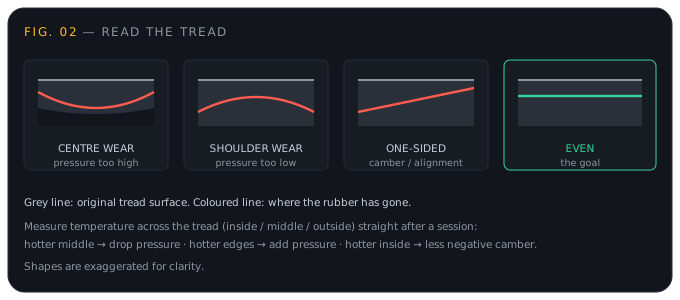
- Centre worn faster than edges: pressure is too high.
- Both shoulders worn, centre fine: pressure is too low, or you’re driving the tyre past its limit with too much slip.
- One side much more than the other: camber or alignment. On the outside front, too little negative camber wears the outer shoulder. Too much wears the inner.
- Wear that’s even, but heavy: the tyre is doing its job, but you’re running it hot or sliding it a lot.
Use a temperature probe or pyrometer straight after a session, taking readings inside, middle and outside across the tread. That gives you the same story as the wear, but within one session rather than over a weekend:
- hotter in the middle than the edges → release pressure
- hotter at the edges than the middle → add pressure
- hotter on the inside → less negative camber (or more, if the outside is the hot one)
Managing a set across a day
Think of a tyre as a fixed budget of laps at full performance. You decide how to spend it.
Warm up properly. Two or three gentle laps, weaving on the straights and building speed, gets heat in without shock-loading cold rubber. Don’t go for a lap time on lap one.
Don’t slide for fun in the early stages. Wheelspin and big slides generate a lot of surface heat quickly and wear the tread fast. If your goal is lap time, the quickest line is the one that uses the tyre smoothly.
Cool down. One slow lap at the end of a session lets temperatures and pressures drop gradually, and it protects the brakes too. A glowing hot tyre parked on a stand is also more likely to flat-spot and heat-cycle.
Know your limits for the day. Many people find a tyre’s best laps come after a short break-in and a cool-down, and begin fading after a certain amount of use. Learn where that is for your tyre and plan your sessions around it.
Rotate when it helps. Front-drive and rear-drive cars wear differently, and a heavy track day can eat the front pair or the driven pair much faster than the others. Swapping sides or ends between days (within the tyre’s rotation rules) evens it out.
Store them well. Keep tyres out of direct sunlight, away from heat and chemicals, and clean. A tyre that’s been sat baking in a boot for six months isn’t the same tyre.
Heat cycles and age
Track tyres age in two ways: by use and by time. Each time a tyre goes through a hot session and cools down it’s a heat cycle, and the rubber gradually hardens. A set that’s had ten hard cycles and sat in a garage for two summers will grip less than the numbers on the tread suggest, even if the tread depth looks fine.
Rules of thumb:
- If a tyre has gone hard and shiny, or has cracks, or has been through many cycles, it’s time to retire it from track use.
- Look at the date code on the sidewall. Old tyres lose grip no matter how little tread they’ve used.
- Replace pairs, not singles, so grip is matched across an axle.
Safety first
Never run a tyre with cord showing, bulges, cuts in the sidewall, or damage that you can’t explain. Check them before every session, not just the first. Tyre pressure checks should be hands-on, and if a gauge looks wrong, trust the tyre more than the number.
Keeping notes (and letting Outlap help)
The best tyre advice is the advice you’ve written down for your own car. Record, at least:
- tyre model, size and date code
- cold pressures in, hot pressures out
- circuit, weather and track temperature
- how the car felt and what the wear looked like
Outlap’s Garage keeps your cars and tyres in one place, and the tyre library holds pressure and temperature windows for compounds like the Cup 2, so you can compare your numbers to what the tyre is designed for. Add your session notes alongside your laps and you’ll soon see patterns, like “this tyre drops off at lap 14 when it’s above 28°C”.
A one-page plan for your next track day
- Before you leave: check tyre condition and date codes. Set cold pressures slightly under your usual track number.
- First session: easy warm-up, then build. Come in and check hot pressures.
- Adjust: change pressures towards the target. Make one change at a time.
- Mid-day: check for wear patterns and temperatures across the tread. Adjust pressure or camber if something is obviously off.
- Last session: you’ll know the tyre now, so spend what’s left of it. Finish with a cool-down lap.
- After: log it, store the tyres properly, and you’ll be quicker next time before you’ve changed a single part.
Tyres reward attention, and they don’t ask for much: a good gauge, a notebook, and a few minutes in the pit lane after each session.